

Personal safety starts with knowledge, awareness, and confidence—not fear. Our Foundational Level 1 Self-Defense Skills program is designed to empower participants with practical tools they can use immediately in everyday situations. This level focuses on prevention, clear decision-making, and simple, effective movements that prioritize escape and safety.
Below is an overview of the core principles covered in this foundational training.
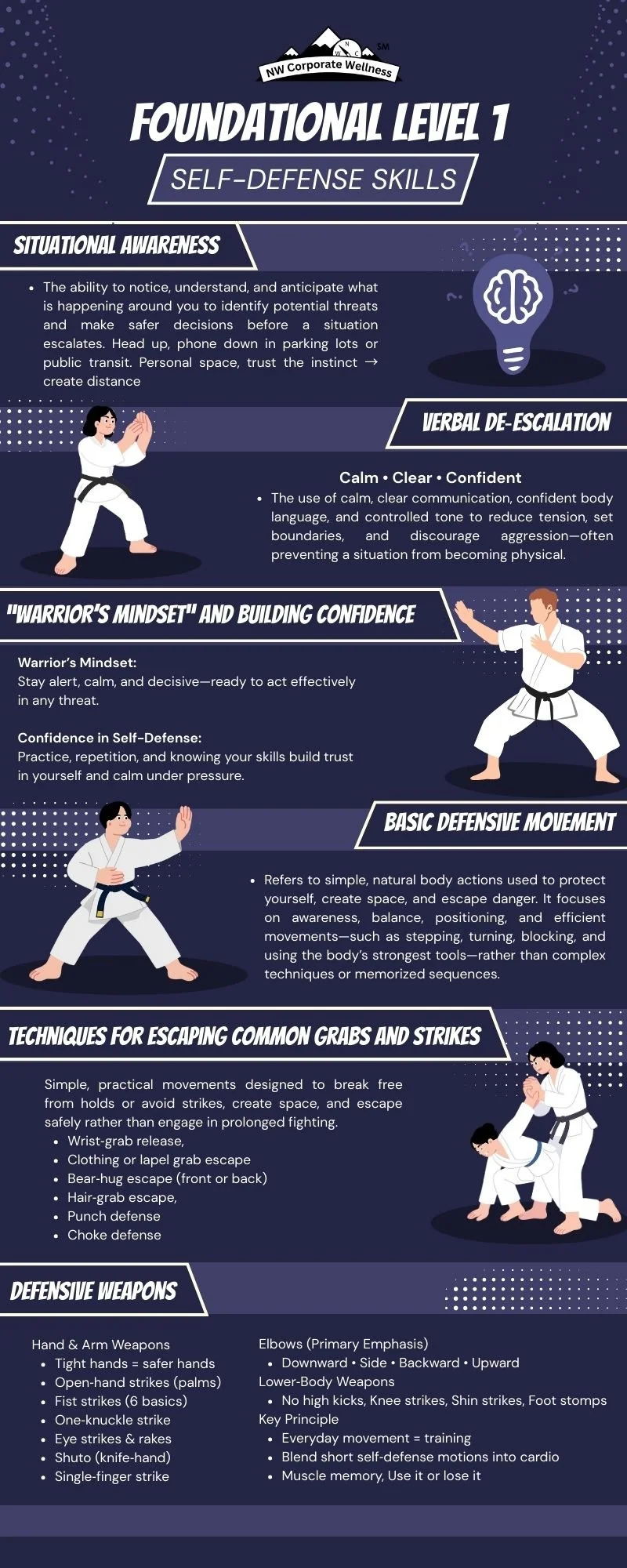
Situational Awareness: Your First Line of Defense
Situational awareness is the ability to notice, understand, and anticipate what’s happening around you. This skill helps you identify potential threats early and make safe decisions before a situation escalates.
Key elements include:
Staying alert and minimizing distractions (head up, phone down)
Being aware in parking lots, public transit, and shared spaces
Respecting personal space
Trusting your instincts and creating distance when something feels off
Awareness often prevents danger before it begins.
Verbal De-Escalation: Calm, Clear, and Confident Communication
Many confrontations can be avoided or diffused through effective communication. Verbal de-escalation focuses on using calm, clear language, confident body posture, and controlled tone to reduce tension and discourage aggression.
This approach helps participants:
Set clear boundaries
Project confidence
Prevent situations from becoming physical whenever possible
Strong communication is a powerful safety tool.
Warrior’s Mindset and Building Confidence
Self-defense is as much mental as it is physical. Developing a “warrior’s mindset” means staying alert, calm, and decisive—ready to act if necessary without panic.
Confidence in self-defense is built through:
Practice and repetition
Understanding your capabilities
Learning to stay calm under pressure
Confidence changes how you carry yourself—and how others perceive you.
Basic Defensive Movement
Rather than complex techniques or memorized sequences, this training emphasizes simple, natural body movements that are easy to recall under stress.
Participants learn to:
Protect themselves using balance and positioning
Create space to escape danger
Use stepping, turning, blocking, and efficient movement
Rely on the body’s strongest tools instead of complicated techniques
The goal is safety and escape, not prolonged engagement.
Techniques for Escaping Common Grabs and Strikes
Foundational Level 1 includes practical techniques designed to break free and get to safety quickly. These movements focus on real-world scenarios and prioritize escape.
Covered techniques include:
Wrist-grab releases
Clothing or lapel grab escapes
Bear-hug escapes (front and back)
Hair-grab escapes
Punch defense
Choke defense
Each technique is designed to be simple, effective, and easy to remember.
Defensive Weapons: Using the Body Effectively
Participants are taught how to use their body as a defensive tool in a controlled and practical way.
Key concepts include:
Hand & Arm Weapons
Tight hands for safety
Open-hand (palm) strikes
Basic fist strikes
One-knuckle strikes
Eye strikes and rakes
Knife-hand (shuto) strikes
Single-finger strikes
Elbows (Primary Emphasis)
Downward, side, backward, and upward elbow strikes
Lower-Body Weapons
Knee strikes
Shin strikes
Foot stomps
No high kicks—focus stays grounded and realistic
Key Principles
Everyday movement equals training
Blending short self-defense motions into cardio and fitness
Building muscle memory through repetition
“Use it or lose it” skill retention
A Practical, Empowering Approach to Safety
This foundational program is designed to be accessible, empowering, and realistic. Participants leave with increased awareness, confidence, and practical tools they can apply immediately in daily life.
Self-defense isn’t about fighting—it’s about awareness, preparedness, and the ability to protect yourself and get home safely.